
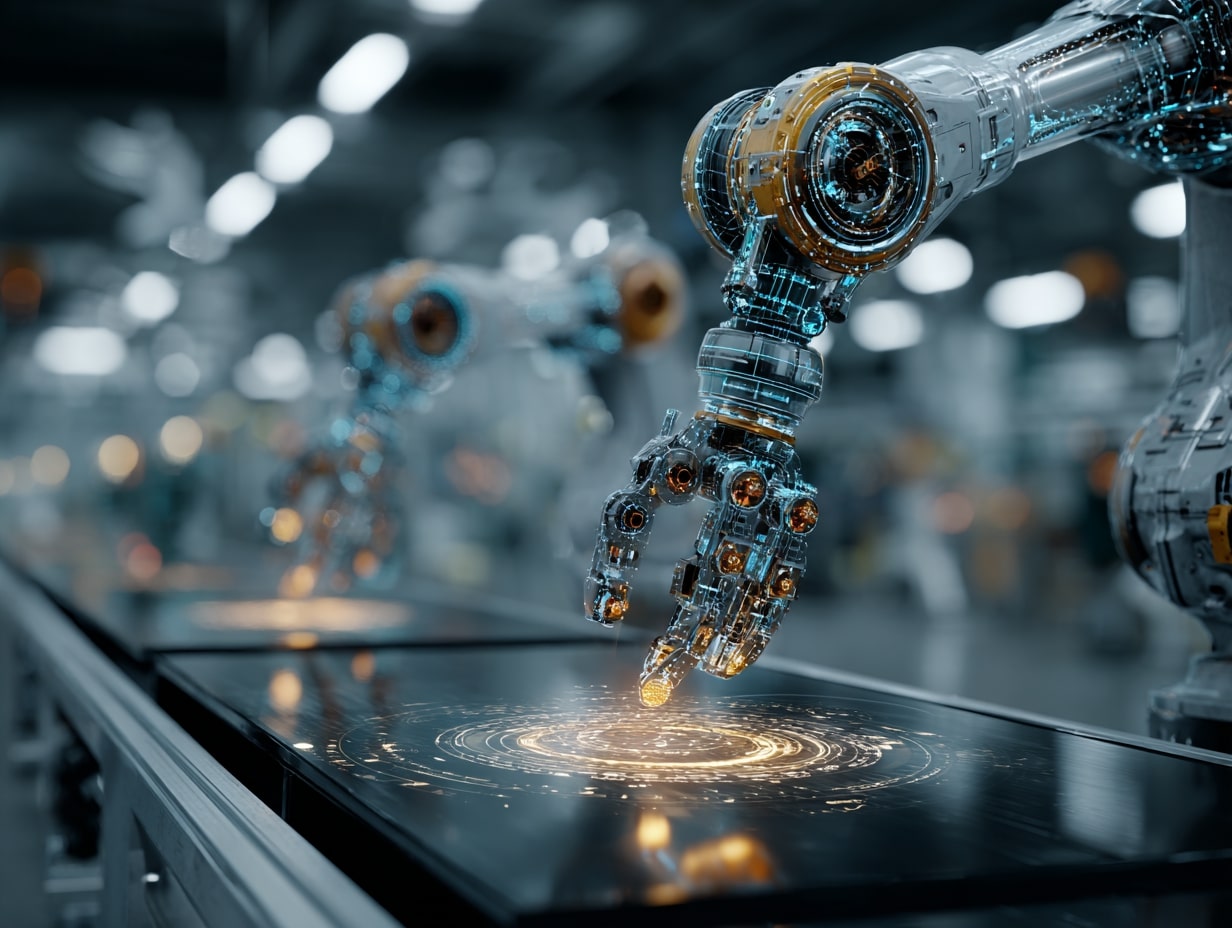
Dream-1 aims to transfer skills from one robot to another
Dream Labs launches a public API for Dream-1, a model designed to transfer skills between different robots. The startup, founded by former NVIDIA robotics researchers, also raised $90 million in seed funding.
Dream Labs, a start-up founded by former NVIDIA robotics researchers, has raised 90 million dollars in seed funding and launched a public API for Dream-1, a model designed to transfer skills between different robots. The challenge is simple to state and costly to solve: a robot that learns a task does not automatically know how to perform it on another machine. With Dream-1, the company aims to offer a common base, then adapt it when hardware or usage requires.
A common model to avoid starting from scratch
Dream Labs presents Dream-1 as a World Action Model, that is, a system that links the understanding of a video scene to the robot's actions. The model predicts both what will happen in the image and what the robot should do next. This approach matters because robotic arms do not all have the same geometry or mechanical constraints.
Rather than sending identical joint commands everywhere, Dream-1 predicts positions and orientations of the end effector, as well as the open or closed state of the gripper. Each robot then translates these instructions via its own inverse kinematics solver, in other words the module that converts a target into joint movements. The result is a common interface, without perfectly standardized hardware. Which, for robotics, is almost a bureaucratic miracle.
An API, a Playground and clearly defined limits
The launch is not limited to a research announcement. Dream Labs offers an API, a fine-tuning service, and a Robot Playground accessible from the browser, with physical robots located in its San Francisco offices. Developers can thus send instructions, test the model's behavior, and measure its failures without having to set up the entire infrastructure themselves. The model is however in research beta and the company specifies that it is not validated for critical safety uses.
The zero-shot transfer capability — when the model attempts a task on an unknown robot without specific demonstrations — remains targeted. Dream Labs currently limits it to bimanual robots equipped with parallel grippers. Its published evaluations cover 27 unseen robots in simulation, with 300 executions per configuration. Scores vary greatly depending on the hardware [to be verified], which reminds us that inter-robot transfer neither erases morphological differences nor the limits of physical environments.
The real issue is adaptation after the first try
When the generic model is not enough, Dream Labs pushes fine-tuning as a service. Developers can upload demonstrations from their own robot and receive an adapted model, instead of launching a training project from scratch. The company shows examples with five minutes of robot-specific data, but also indicates that some configurations require many more examples, notably with less familiar end effectors. So this is not a magic recipe, rather a shortcut to a usable starting point.
The pricing displayed on the research page is 3 dollars per hour for Dream-1 and 2 dollars per hour for Dream-1-flash, with 1.6 seconds of actions generated per call. Added to this are hardware, integration, and operating costs. This is where the market will judge the proposition: a model can promise skill transfer, but it still needs to prove that it really reduces engineering time and the volume of data needed to automate a given task.
From research to a service teams can test
Dream Labs, which builds on some of its previous work around DreamZero and NVIDIA's robotics research on GR00T, is turning an academic prototype into a testable product. The opening of a public API counts almost as much as the model itself, as it gives access to developers who can see where it works, but also where it breaks. This is often where the real value of a robotics tool appears, far from well-lit demonstrations.
The future will mainly depend on the robustness of transfer between different machines, the real need for robot-specific data, and Dream Labs' ability to expand its support beyond bimanual systems with simple grippers. For now, the company puts forward a clear bet: to circulate skills from one robot to another, without forcing each team to reinvent the wheel, or the gripper.
By the numbers
- 90 million dollars — seed raised by Dream Labs, according to the announcement.
- 27 robots — embodiments tested in simulation, according to the published research.
- 300 executions — per configuration tested in simulation.
- 3 dollars per hour — price listed for Dream-1.
- 1.6 seconds — of actions generated per call, according to the research page.

