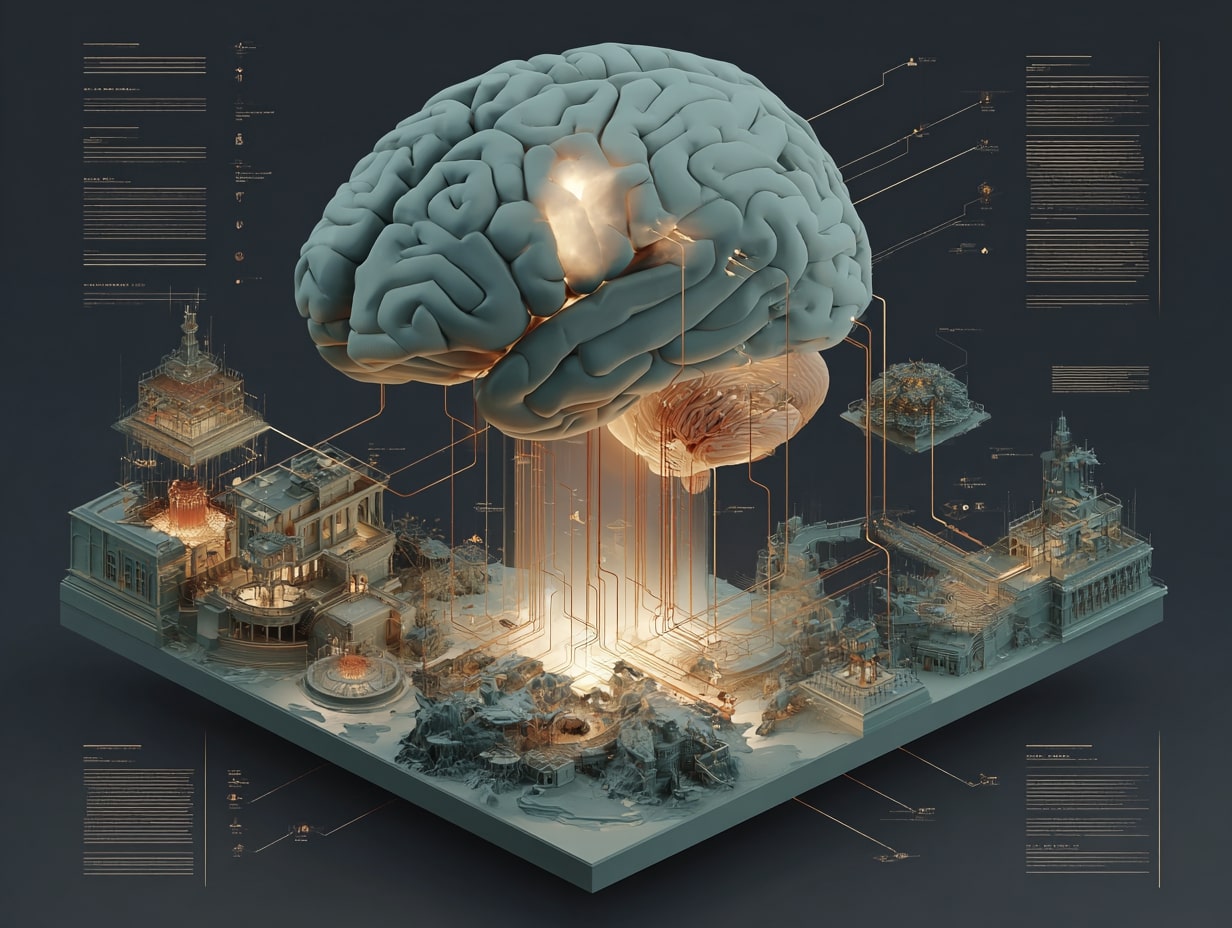
Genie 4 aims to make simulated worlds more believable
Google DeepMind is testing Genie 4, a version of its world model capable of adding native sound, editing scenes live, and relying more on Gemini. The tool remains limited to trusted testers.
Google DeepMind has unveiled Genie 4 in a limited research preview, featuring native sound, more flexible live scene editing, and enhanced integration with Gemini. This world model, designed to simulate interactive environments, can be controlled via keyboard, modified on the fly, and used to test agents or robots before deployment in the real world. There is a very concrete limitation: according to the launch briefing, simulations last about two minutes before visual details and object consistency degrade.
Un simulateur plus souple, mais pas encore inusable
Genie 4 belongs to the family of world models, that is, AI systems that aim to predict the evolution of an environment over time. Google states that users can change the weather, move the camera, add characters or objects without restarting the simulation. The goal is a more vivid rendering, with ambient sounds, music, reactive dialogues, and more believable physical interactions. On paper, the scene holds up better. In practice, the setting still eventually cracks.
This fragility matters because it limits uses that require long and reliable continuity. For prototypes, demonstrations, or quick tests, the two-minute window is sometimes sufficient. For a robust simulation, it is short. Very short. Google also admits that visual quality and object consistency can degrade over time, reminding us that an artificial world is easier to promise than to maintain.
Gemini prend la main sur la mise en scène
Google does not just add effects. The company also relies on Gemini to coordinate more complex events in the simulation. Gemini Omni helps anchor scenes in behaviors and appearances considered more realistic, while Gemini 3.8 Flash tracks incoming images, breaks down objectives into steps, and adjusts the plan as events unfold. In other words, the model does not just display a scene: it also tries to manage it.
In a separate test, Google combined Genie 4 with Gemini 4 Argon to simulate Apptronik’s humanoid robot Apollo playing checkers. Argon breaks down the task, Genie 4 visualizes it step by step. The exercise mainly explores a simple idea: testing robots and agents in a digital sandbox before sending them into the physical world. It is cautious and probably less costly than a real accident.
Un marché encore flou pour les modèles de monde
The topic attracts investments but also reservations. According to examples cited by Techstrong, potential uses range from virtual sets for film studios to dangerous traffic scenarios for autonomous vehicles. Yet approaches vary greatly between players: some focus mainly on visual realism, others on physical prediction. As a result, even the definition of what a world model is lacks consensus.
Doubts mainly concern the ability to correctly simulate causes and effects. Techstrong cites the What-If World benchmark, which tested nine video generation models on their ability to reproduce consequences of physical changes: none scored above 52%. Genie was not included, but the signal is clear. Between a scene that looks right and a scene that behaves like reality, the gap remains significant.
Ce que Google prépare pour la suite
For now, Genie 4 is accessible only to trusted testers. Google plans to expand access via Project Genie for Google AI Ultra subscribers, as well as certain partners of the Gemini API and Google AI Studio, without giving a date. This gradual rollout shows a classic strategy at Google DeepMind: lock down access first, observe usage, then open wider if the technology holds up.
The movement also interests the broader market. World models are gaining more visibility in the AI race, with Nvidia, Meta, Runway, Fei-Fei Li’s World Labs, and Yann LeCun’s AMI Labs among the names mentioned in the source report. But the central question remains: do these systems only know how to create convincing worlds, or can they also simulate their rules? For now, Genie 4 mainly shows that Google wants to do both.
Key points
- Genie 4 is in limited research preview at Google DeepMind.
- The simulation lasts about two minutes according to the launch briefing.
- Gemini 3.8 Flash coordinates the scene’s steps.
- Apptronik and its robot Apollo are used in a humanoid test.
- Google promises expanded access via Project Genie, with no date given.
By the numbers
- 2 minutes — approximate duration of a simulation, according to Google’s launch briefing.
- 9 models — tested in the What-If World benchmark cited by Techstrong.
- 52% — best score observed on this benchmark, no model does better.
- Over 2 billion dollars — combined amount raised earlier this year by World Labs and AMI Labs, according to the source brief.