
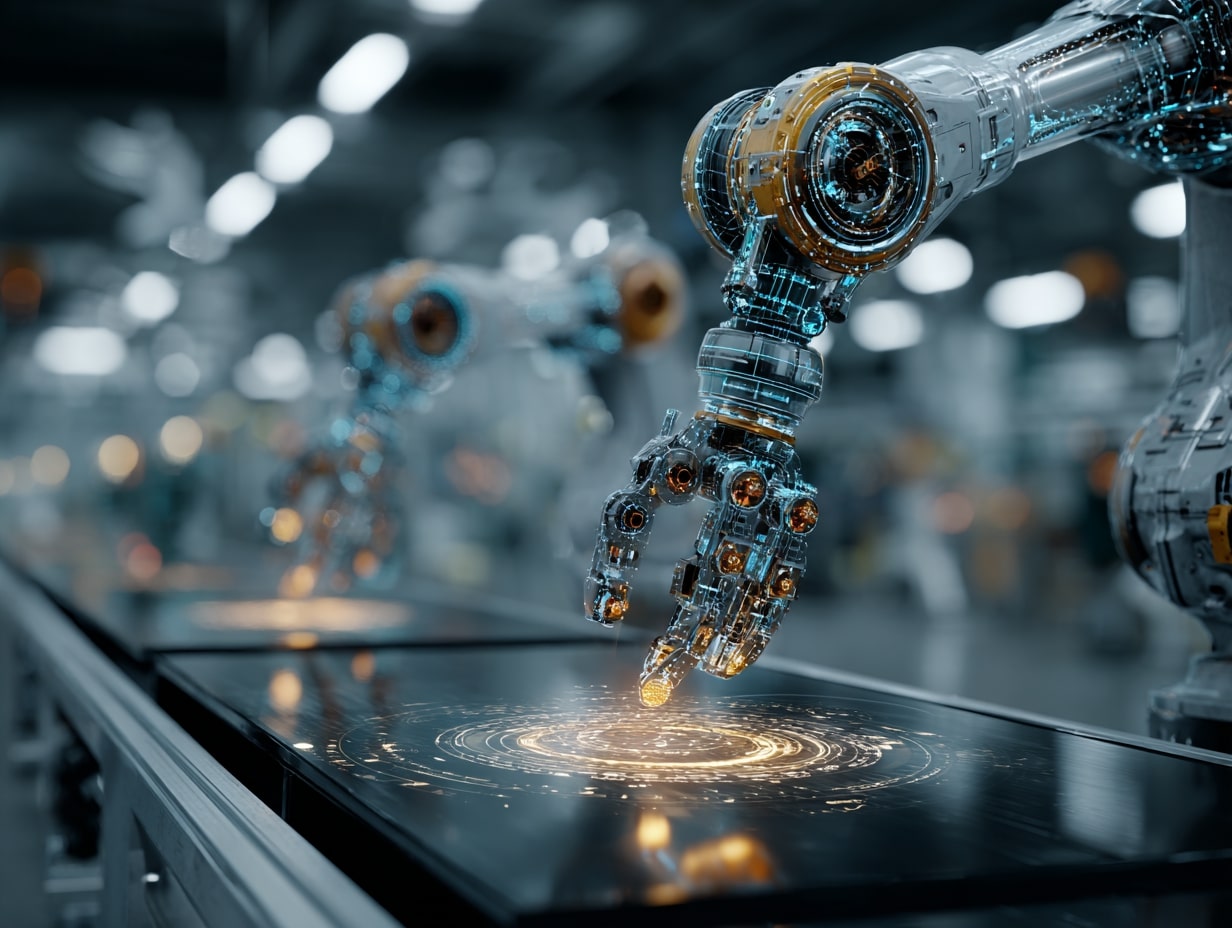
OpenAI reshuffles robotics while Anthropic accelerates
OpenAI redistributes its robotics teams to its research and application hubs. Meanwhile, a former Anthropic researcher states that efficiency improvements make models faster to retrain.
OpenAI is reorganizing its robotics division by reallocating its researchers to other teams, even though the company had relaunched this initiative in 2024 and aimed for a first public robot demonstrator by 2027, according to Fortune. The move reflects a specific technical bet: generalist models like GPT-6 Astra could control robots without specialized models, which changes the hierarchy of priorities in the lab. Meanwhile, a former Anthropic researcher argues that model efficiency is improving fast enough to allow retrainings at lower cost. Two distinct signals, but telling the same story: robotics and training computation are moving closer to industrial logic.
Chez OpenAI, la robotique passe sous d’autres bannes
OpenAI has decided to transfer its robotics researchers to the main research team, led by Mark Chen, while the applied and hardware teams join the Applied organization led by Greg Brockman, according to Fortune. The company reportedly made this decision so quickly that a booth already reserved for the CoRL conference in Austin remained empty. However, there is no indication of a pure and simple abandonment: OpenAI had already closed its robotics division in 2020 due to insufficient training data, before rebuilding it in 2024.
The change of direction is based on a hypothesis that has become credible in the company's eyes: large generalist models could directly control robots without a dedicated specialization layer. In the cited tests, an agent powered by Astra achieved a 74.8% success rate on simulated robotic tasks, compared to 51% for the best specialized models, in a benchmark conducted with a simulated DROID robot. Another benchmark, StationeryBench, compared GPT-6 Astra to Ai2 and its MolmoAct2 model on five tasks with office objects and dual-arm YAM arms: Astra fully succeeded in 7 out of 100 tasks, while MolmoAct2 completed none. The figures remain related to simulation, not a physical robot.
Les modèles généralistes prennent de l’avance, mais pas tous les coûts
This rise in power does not solve everything. Specialized models retain very concrete advantages in cost, reliability, execution speed, and energy consumption, even if they generalize less well. In other words, a generalist model can impress in demonstration, but the bill and robustness will decide long-term viability. Yoav Artzi, a researcher at Cornell University and Google DeepMind, sees Astra as a leap in spatial understanding and says the model achieves near-human accuracy on the REMAP benchmark, still unpublished. He also assumes OpenAI may have trained the system with large amounts of 3D data, such as Blender scenes [to be verified].
This interpretation fits into a broader tension at OpenAI. The company still wants to build its own everyday robots in the long term, but it is also under financial pressure to focus its resources on its core business, where it may have lost ground to Anthropic. In practice, robotics remains a strategic file, but not necessarily a stable budgetary center of gravity.
Chez Anthropic, le vrai sujet n’est plus seulement le modèle, mais le rythme
On the other side of the market, Jacob Coxon, a former researcher at OpenAI then Anthropic, criticized a chart shown in Anthropic’s IPO roadshow. According to him, the curve of compute needed for training is steep enough to show an algorithmic improvement that is not only rapid but accelerating. He writes that Mythos, a model presented as a major breakthrough in spring, was not an isolated rupture but a point on a "superexponential" trajectory. Above all, he claims Anthropic could already retrain Mythos with a fraction of the initially required compute.
The detail matters because it shifts the discussion from the simple “bigger model” to the ability to redo the same work with fewer resources. Coxon goes as far as saying these gains are "on the verge of being automated," and advocates for a pause in training frontier models next year to let competitors catch up. He believes such a freeze would "commoditize human-level intelligence. It would only harm OpenAI and Anthropic." The statement is blunt but sums up the issue well: if efficiency continues to rise, the lead is no longer just about model size, but about how fast one can remake them better and cheaper.
By the numbers
- 74.8% — success rate of an Astra agent on simulated robotic tasks, Nvidia study, 2026.
- 51% — best score of specialized models in the same test, Nvidia study, 2026.
- 200 trials — total volume of StationeryBench, comparing Astra and MolmoAct2, 2026.
- 7 tasks out of 100 — tasks fully completed by Astra on StationeryBench, 2026.
- 0 tasks out of 100 — complete result of MolmoAct2 on StationeryBench, 2026.

