
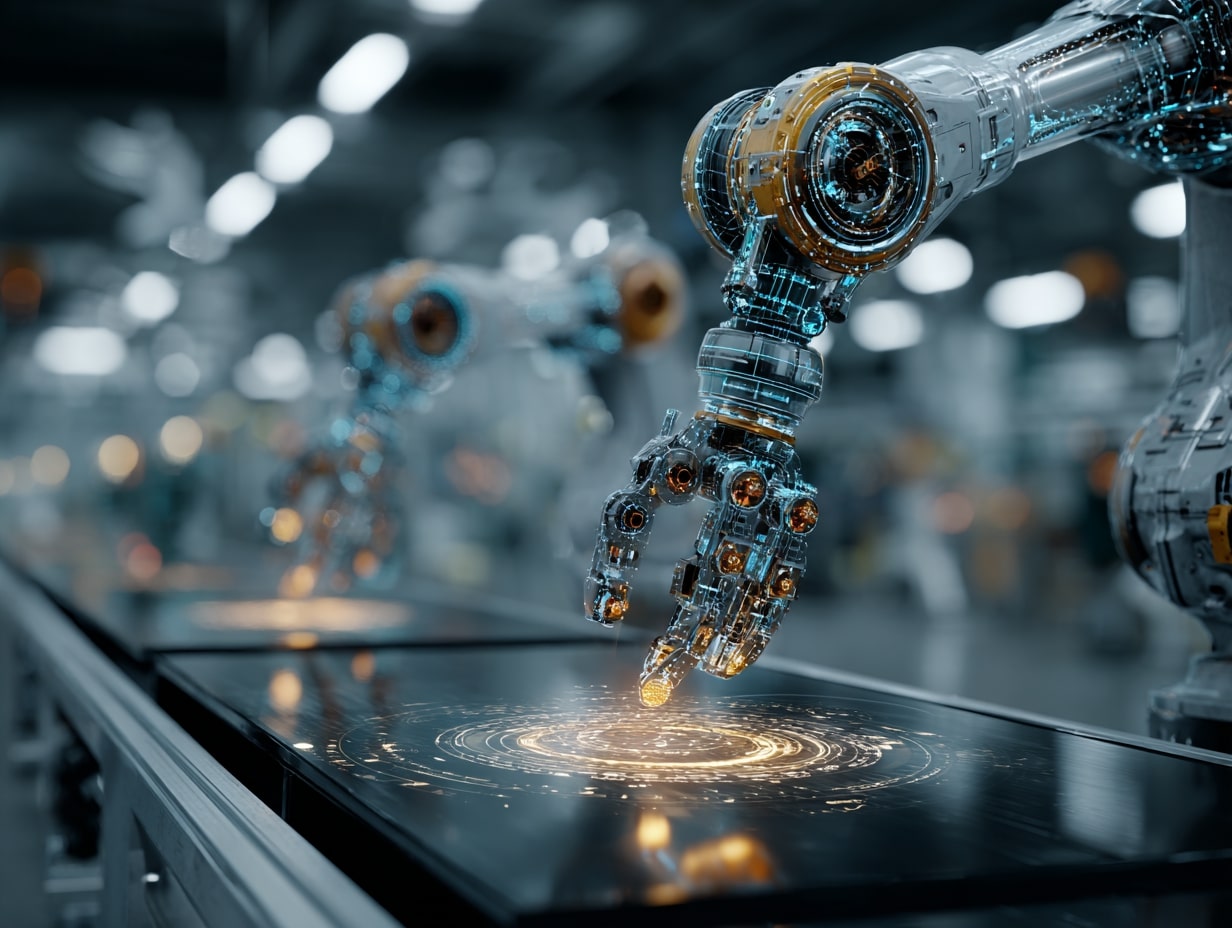
Eka Robotics aims to scale robotic grasping
Startup Eka Robotics raises 150 million dollars in Series A and reaches a valuation of 1.45 billion dollars. Its bet: a Vision-Force-Action model capable of improving robot grasping through force feedback.
Eka Robotics, a robotics startup founded by Pulkit Agrawal and Tuomas Haarnoja, raised 150 million dollars in Series A, according to an announcement published on October 20, 2026, by Andreessen Horowitz. The company is now valued at 1.45 billion dollars post-money. Its goal is clear: to make robots capable of grasping, adjusting, and manipulating objects more reliably in industrial environments still difficult to automate.
Why force changes the game
The core of Eka’s thesis is summed up in three words: Vision-Force-Action. Simply put, the robot relies not only on what it sees but also on what it feels when touching the object. This difference matters because grasping often fails at that crucial last millimeter where an object slips, rotates, or resists during insertion.
According to Eka, current robots remain limited when it comes to handling varied objects without constant manual adjustment. The startup explains it has jointly designed the model, perception, controller, and hardware so that physical contact becomes a source of information, not just an incident. A gripper that detects a slipping grip can correct its movement. An insertion attempt can readjust if resistance changes. It’s less spectacular than an arm waving in a demo video but much more useful on the factory floor.
A model trained in simulation, not in entire warehouses
Eka relies on reinforcement learning in physical simulation. This method allows virtual robots to try millions of variations in position, friction, or contact before moving to real machines. The startup estimates it can generate thousands of hours of robotic experience in minutes.
The difference with learning from human demonstrations is clear. Training videos show what to do but not all the ways to fail. Here, the idea is to grow experience with computing power, not with data collection teams. The classic industry pitfall remains: the gap between simulation and reality. The laws of physics have a limited sense of humor but like to remind us that a soft material in reality does not always behave like in a simulator.
Promising performance, but still to be confirmed in production
In pick-and-place and bin picking tasks, Eka claims to reach about 1,500 picks per hour, compared to about 600 for a human, with a success rate above 95% according to TechCrunch. Andreessen Horowitz adds that the system has shown capabilities on fragile objects, slippery industrial parts, and insertion tasks with contact. The startup also states that its gripper hardware costs less than 1,000 dollars and aims for 5 million usage cycles, with a goal of 20 million, a threshold mentioned for standard industrial arms.
However, these figures should be taken as lab and pilot results, not large-scale validation. Eka is already working with several industrial clients on cases like pick-and-place and wire handling, but the real test will come on real assembly lines, over time, with near-zero failure rates. This is where robotics projects often move from PowerPoint to the machine room.
An industrial thesis beyond demonstration
For Andreessen Horowitz, dexterous grasping is one of robotics’ major bottlenecks. Many physical tasks remain difficult to automate, especially in manufacturing, electronics, logistics, or food processing, because the real world is variable: parts move, materials deform, objects slip, and connectors don’t always fit on the first try. If Eka manages to make its technology robust, it could reduce dependence on manual labor in chains where classic automation still stops too early.
The founders claim a pragmatic approach. Pulkit Agrawal, MIT professor, and Tuomas Haarnoja, former Google DeepMind researcher, say they want to first succeed in two verticals: sorting, arranging, picking and placing, as well as wire manipulation. Only then will the ambition expand. In robotics, it is often better to win a very concrete battle than to promise the moon with a gripper.
What investors are looking at
The round is led by a16z and F-Prime. The message is clear: investors want AI models capable of achieving useful performance in the physical world, not just generalist systems that understand instructions but struggle to translate them into reliable actions. Andreessen Horowitz presents Eka as an attempt to bridge the gap between generality and performance, a problem still hindering many industrial uses.
If the company succeeds, it could shift part of robotics from demonstration to industrial operation. If it fails, it will join the long list of models very impressive on video but much less convincing at the end of a production line. For now, Eka has mainly shown it can attract money and raise high expectations. The future will tell if the robotic hand really holds up.
By the numbers
- 150 million dollars — Series A announced on October 20, 2026, according to TechCrunch.
- 1.45 billion dollars — post-money valuation, according to TechCrunch.
- 1,500 picks per hour — performance announced in the lab, about 2.5 times a human.
- 95%+ — success rate announced by Eka for object grasping.
- Less than 1,000 dollars — announced cost of the gripper hardware.